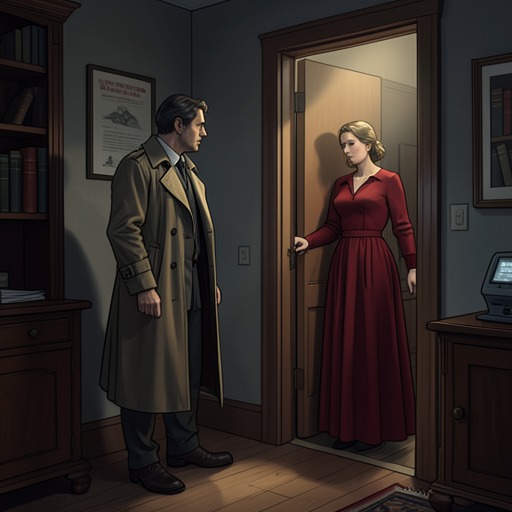
Brick Decides Not to Kill Janae
I'm Still Here- What didn't kill me made me stronger and sharperJensen Brick McCall’s decision not to kill Janae Morrison begins with a paid assignment and turns on their first encounter aboard a bus: faced with the woman he has been hired to destroy, he holds back, warns her, and allows their conversation to continue. The reversal interrupts a plan backed by a $25,000 payment and gives Janae, initially only a face in a photograph and a target in a client’s demand, the chance to become a person Brick must reckon with.
The Contract and Its Target
Before meeting Janae, Brick has already read about her in the newspaper while stranded in Buffalo for four hours. He understands that money has changed hands to have her dealt with on behalf of a scorned wife. The client arrives with red eyes, expensive boots, a Michael Kors purse, and a large diamond ring, then hands Brick Janae’s picture. The payment is transferred to his bank account in the amount of $25,000. The contrast is stark: an affluent client can turn private humiliation into a paid threat, while the woman marked for harm is, at this stage, known to Brick through news stories and an image.
The client’s order is to get rid of Janae Morrison. When Brick asks what that means in practice, he names several forms of violence, from paralysis to shooting or snapping her neck. The client does not choose one method; she demands that he destroy Janae as severely as he can and ensure she never returns to Buffalo. The instruction leaves the brutality open-ended but makes the intended result unmistakable: Janae is to be driven out and harmed. Looking at the photograph, Brick sees an attractive, apparently innocent woman caught up in a relationship, not simply the disposable target his employer wants him to see.
The Bus Encounter and the Withheld Violence
The photograph becomes a living person when Brick finds Janae sitting beside him on the bus. He thinks she should have been dead before she even reached the bus steps, yet he does not immediately carry out the assignment. News articles and videos have already shaped his view of her as a woman caught up in a damaging romance; now he has to decide whether the person in front of him is someone he will help. The distance between a target known through media and a woman sharing his seat turns the contract into an immediate personal choice.
Janae hands him the brown envelope. Brick tells her to put her money away and warns that, had he intended to kill her, she would already be dead. He also cautions her against making assumptions about people or freely handing over her valuables. Janae snatches the envelope back and stuffs it into her bra. The exchange is deliberately unsettling: Brick lets her believe for a moment that she has placed herself in danger, then makes clear that he is not taking her cash or attacking her. His warning does not erase the threat he represents, but it gives her a chance to protect herself from him.
He explains that he recognized her from the newspaper and the news, then asks whether that is why she is on the bus. Janae snaps that her reasons are none of his business. Brick nearly responds to her attitude with violence, thinking that he could snap her neck within seconds, but restrains himself. He does not want the attention or felony exposure, and his immediate mission, as he describes it, is to approach his own murderer. The contract remains active in the background, but the encounter's balance changes: he has the opportunity to hurt her and consciously does not take it.
Brick rebukes Janae for her tone and tells her that the man she is running from promised her the world but left her with something worthless. He says she should be grateful that he did not act on what he wanted to do, and that a less scrupulous person might have taken her money and run. Janae turns toward the window and folds her arms rather than continuing the argument. As she does, Brick notices several parallel cut marks across her wrists. She sees him looking and pulls down her sleeve. The marks make visible a private pain she does not explain; the scene offers no account of when or why they were made, and Brick's decision not to kill her should not be mistaken for a stated response to them.
The confrontation ends with Janae asserting a small but important boundary: she thanks him, then corrects him that she is not his mother and gives her name. Brick observes her round face, the single dimple in her right cheek, Vaseline on her lips, and curls left by recently removed braids; then he extends his hand and introduces himself. The sequence moves from a paid threat and a near-act of violence to a first exchange of names. Brick has not yet resolved the larger danger surrounding Janae, but he has stopped treating the encounter as an occasion to carry out the contract.
A Reprieve, Not a Release from the Contract
Brick’s restraint is consequential, but the scene does not present it as a complete renunciation of the assignment. He imagines how quickly he could snap Janae’s neck, then checks himself in part because he does not want police attention or a felony. His immediate choice is therefore bounded and practical as well as humane: he withholds violence in the encounter, while the client’s demand and the money already transferred remain part of the situation. The distinction matters. Janae is spared in this moment, but the danger surrounding her has not been resolved simply because Brick does not act.
Nor does Brick cast himself as an uncomplicated protector. He warns Janae that she is fortunate he did not do what he wanted, and contrasts his conduct with what a less scrupulous person might have done with her cash. That warning makes his restraint legible to her as a reprieve offered by someone still capable of harming her. The scene holds those facts together rather than converting his decision into instant trust: he has chosen not to attack, but his own account of the choice keeps the threat close.
The exchange of names offers a smaller, more measured turn. Janae rejects the familiar label Brick uses for her, thanks him, and insists that her name is Janae. Brick responds by looking closely at her face and appearance, then extending his hand and introducing himself. The passage does not claim that this gesture settles their relationship; it marks a change in how the encounter can proceed. The assignment began with a photograph and an order to erase a woman from Buffalo. It now ends with both people named, and with Brick having allowed the person in front of him to remain alive.
Narrative Function and Significance
The encounter is arranged as a reversal of perspective. Before Janae Morrison appears beside him, Jensen Brick McCall has received her photograph, read about her in the news, and heard an order that treats her future as something money can purchase. On the bus, the assignment becomes an encounter with a person who speaks back, protects her belongings, and insists on being addressed by her name. That shift does not erase the violence of the contract or make Jensen Brick McCall’s restraint a settled promise of safety; it changes what he does at the point where he could act. The scene’s movement from an image and an order to a face-to-face introduction gives the decision its force: Janae is no longer only the person someone paid him to remove, and the first exchange of names leaves their next interaction open rather than resolved.